A serious injury requires more than a clinic that stays open late: you need rapid assessment, stabilisation, appropriate imaging, treatment decisions and a safe plan for what happens next. By the end, you will know when to call 112, what care to expect from arrival through discharge, and which hospital capabilities to confirm before you travel or arrange a transfer.
Key takeaways
- Call 112 for unsafe scenes, unconsciousness, poor breathing, severe bleeding, or entrapment.
- Go to emergency trauma care for deformity, uncontrolled bleeding, head injury, or inability to bear weight.
- Ask whether imaging, splinting, surgery, orthopedics, and rehabilitation are available around the clock.
- Carry identification, medication details, scans, and injury information during transfer or admission.
What happens before and during arrival at a trauma hospital
Call 112 before travelling if the scene is unsafe, the person is unconscious, breathing poorly, bleeding heavily, or trapped.
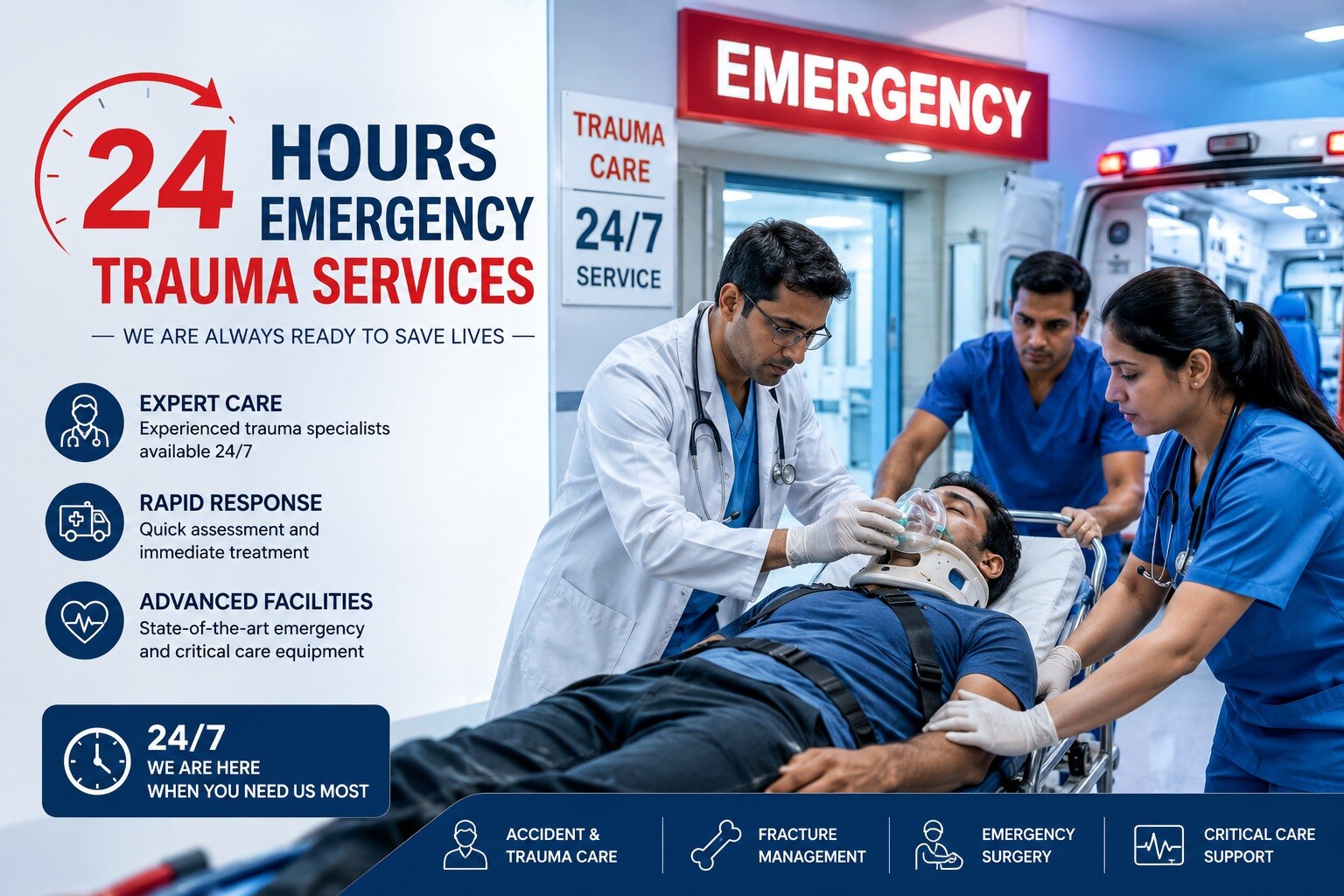
Knowing what does a 24 hour trauma hospital provide in Pune helps you choose the right destination: a continuously staffed emergency department should offer triage, resuscitation, pain relief, bleeding control, wound care, fracture immobilisation and urgent surgical assessment.
Confirm overnight imaging, blood products, an operating theatre, intensive care and specialist availability before transferring an unstable patient.
- Do not move anyone with a suspected neck or back injury unless danger forces movement. Keep the head and neck still.
- Press firmly on external bleeding with clean cloth or gauze. Add more material without lifting the first layer if blood soaks through.
- Support a suspected fracture with a splint in the position found. Do not straighten a deformed limb or push exposed bone back inside.
- Give no food or drink when an operation or anaesthesia may be needed. Bring identification, medication details, allergies and previous medical records.
- Tell the emergency team what happened, when it happened, whether consciousness was lost, and whether numbness or weakness developed.
At arrival, clinicians begin a primary survey of airway, breathing, circulation, neurological status and visible injuries, then check vital signs repeatedly. They treat threats immediately: airway obstruction, breathing failure, major bleeding, shock, or serious head and spinal injury.
A patient with a painful but stable fracture may wait while another patient receives resuscitation. A normal first assessment does not exclude internal bleeding, evolving brain injury or compartment syndrome, so reassessment continues.
Which injuries need emergency trauma care rather than a routine appointment
Uncontrolled bleeding, breathing difficulty, fainting, confusion, or a severe head, chest, abdominal, or spinal injury needs immediate emergency attendance. Go now after an amputation, open fracture, severe burn, major crush injury, or limb that is cold, pale, numb, blue, or pulseless.
A visibly bent arm or leg is urgent, but airway failure, shock, or brain injury takes priority over the deformity.
Emergency trauma care kharadi services should reassess you even after initially normal vital signs: internal bleeding, brain swelling, and compartment syndrome can develop later. Seek immediate help after loss of consciousness, repeated vomiting, worsening headache, new weakness, increasing limb tightness, or pain that seems far worse than the injury.
| Emergency care | Use it for | Why delay is risky |
|---|---|---|
| Life-threatening trauma | Breathing trouble, shock, uncontrolled bleeding, spinal signs, amputation, open fracture | Organ damage, paralysis, or permanent limb loss can progress quickly |
| Urgent same-day care | Stable closed fracture, deep wound with controlled bleeding, suspected dislocation, severe sprain, or persistent inability to bear weight | Needs examination, X-ray, immobilisation, or reduction without routine-appointment delay |
| Routine appointment | Mild bruise or sprain with normal sensation, circulation, movement, and improving pain | Emergency resources are unnecessary if no red flags appear |
For a stable minor injury, urgent orthopedic care is enough when bleeding is controlled, the limb is warm with normal sensation and pulse, and you have no head, chest, abdominal, or spinal symptoms. Choose emergency care if those findings change.
How injuries are diagnosed and treated from splinting to surgery
After triage, clinicians repeat vital-sign checks and perform a primary survey for airway, breathing, circulation, disability and major bleeding. They examine the injured skin, wound, deformity, pulses, sensation and movement, then give pain relief, clean wounds and apply a temporary splint.
X-rays usually define a fracture; CT can show complex joint or spine injuries, while ultrasound or other scans may assess internal bleeding or soft-tissue damage. Reassessment matters because compartment syndrome, internal bleeding or brain injury can develop after initially normal observations.
For an orthopedic emergency in Pune, treatment depends on alignment, stability, circulation, nerve function, swelling, contamination, medical fitness and operating capacity.
- Immobilisation: A splint, cast, brace or traction limits movement while swelling settles or a definitive plan is made.
- Reduction: Clinicians realign a displaced bone without an incision, using medication or anaesthesia when needed.
- Fixation: External fixation uses pins and a frame; internal fixation uses plates, screws, nails or wires. Surgery is more likely for unstable, open, severely displaced or joint-involving fractures.
- Observation: A stable injury can remain under repeated pulse, sensation, pain and swelling checks before discharge or review.
- Admission: Hospital care follows when surgery, intravenous treatment, repeated monitoring, major wounds or associated injuries make home care unsafe.
Open fractures, absent pulses, worsening numbness or pain out of proportion require immediate surgical escalation. If vascular, neurosurgical or another specialist service is unavailable, clinicians stabilise the patient and arrange transfer.
How to compare a 24-hour trauma hospital in Pune before you need one
Before choosing an accident hospital in Pune, call the emergency desk and ask what is available at 2 a.m., not only during clinic hours. A 24 hour trauma hospital in Pune needs continuous emergency staffing for triage, resuscitation and reassessment; a late-opening orthopedic clinic is not the same service.
| Verify | Ask for a specific answer |
|---|---|
| Staffing | Is a doctor present in the emergency department, and who provides urgent orthopedic review? Can an anesthetist attend if surgery is needed? |
| Imaging | Are X-ray and CT available overnight, and who reports the images? |
| Operating | Is an operating theatre ready for emergency procedures, or is surgery scheduled only during daytime? |
| Blood | Can the hospital arrange blood grouping, cross-matching and blood products on site or through a named nearby provider? |
| Critical care | Is an ICU bed available, and who manages a patient needing ventilation or close monitoring? |
| Transfer | What happens if the patient needs neurosurgery, vascular surgery or another unavailable specialty? Who arranges the ambulance and shares records? |
| Access and registration | Which entrance receives ambulances, and what identification, consent, insurance or deposit documents are required? |
Write down the answers, the emergency number, address, ambulance route and nearest landmark. Confirm them again before transferring a patient; staffing, beds and blood availability change.
Isha Trauma Care Hospital can fit your shortlist if its emergency desk confirms these points for your injury and arrival time. Do not infer overnight imaging, ICU, blood products or surgery from a hospital’s orthopedic reputation alone.
Related services
24 HOURS EMERGENCY TRAUMA SERVICES 24 HOURS EMERGENCY TRAUMA SERVICES Our 24-Hour Emergency Trauma Services provide immediate medical care for patients facing accidents, serious injuries, fractures, and other... View service → |
DIABETIC WOUND CARE ### Diabetic Wound Care Diabetic wounds require timely and specialized care to prevent infection and serious complications. View service → |
What happens after stabilisation, discharge or transfer
After stabilisation, expect repeated checks of blood pressure, pulse, oxygen level, pain, circulation and sensation in the injured limb. If surgery is planned, staff will review medicines, allergies, blood tests, imaging, fasting instructions, consent, anaesthesia and the expected implant or procedure; stabilisation does not always mean definitive surgery has happened.
At discharge, ask for the diagnosis, prescriptions, dressing or cast instructions, weight-bearing limit, permitted range-of-motion exercises, review date and a written estimate of recovery time. Return immediately for:
- Increasing pain or swelling despite prescribed medicine
- Numb, pale, blue or cold fingers or toes
- Fever, worsening wound redness, pus or a soaked dressing
- Calf pain, chest pain, breathlessness or fainting
- New confusion, weakness or repeated vomiting
Rehabilitation often starts in hospital with safe transfers, breathing exercises and joint movement, then progresses through physiotherapy, walking aids, strengthening and return-to-work guidance. Do not bear weight, remove a splint, drive or resume sports until the treating clinician permits it; exercises safe after a stable fracture can worsen an unfixed injury.
If an accident hospital in Pune cannot provide the required neurosurgical, vascular or intensive-care service, expect a documented transfer plan and ambulance coordination.
Before choosing an orthopedic emergency in Pune, ask for an itemised estimate covering emergency care, imaging, admission, surgery, implants, medicines, ambulance transfer, physiotherapy and follow-up, plus insurance paperwork and refund or deposit terms.
Frequently asked questions
When should you choose emergency trauma care instead of a routine appointment?
Choose emergency care for severe bleeding, breathing problems, loss of consciousness, suspected spine injury, major deformity, severe pain after an accident, or inability to use a limb.
What happens when you arrive at a 24-hour trauma hospital in Pune?
Staff assess breathing, circulation, consciousness, bleeding, pain, and possible spine injuries first. They then arrange examination, X-rays or other imaging, splinting, wound care, medicines, surgery, observation, or transfer.
How are traumatic injuries diagnosed and treated?
Clinicians examine the injury and use tests such as X-rays, CT scans, or MRI when indicated. Treatment can progress from pressure and wound dressing to reduction, splinting, casting, surgery, and rehabilitation.
How can you compare a 24-hour trauma hospital before an emergency?
Check its location, emergency access, orthopaedic coverage, imaging availability, operating theatre access, ambulance coordination, blood-bank arrangements, admission process, and post-discharge rehabilitation.
What happens after a trauma patient is stabilised?
The patient may be discharged with medicines, wound and cast instructions, warning signs, and a follow-up plan; admitted for monitoring or surgery; or transferred to a facility with a required specialist service.